
Academic research is increasingly collaborative and increasingly linked to burnout and mental health struggles among PhD students. This article offers 7 practical, evidence-based steps departments and PhD coordinators can take to support early-stage researchers: from informal encounters and mentoring to authorship clarity and institutional incentives.
WHY ACADEMIC RESEARCH IS BECOMING MORE COLLABORATIVE
The work of researchers in academia is becoming increasingly collaborative. On the one hand, today’s problems and societal challenges are complex and need to be tackled from different angles, with joint skillsets. On the other hand, multi-author collaborations can benefit from insights from multiple angles, bring the ability to publish more papers, apply for more grants and increase dissemination compared to working solo. Thus, across disciplines, scientific teams are increasing in size.
COLLABORATION AND THE ACADEMIC MENTAL HEALTH CRISIS
Yet, with advantages come also novel challenges. The question is not only what makes a research team productive, but also how to care for the well-being of those involved in collaborative research, where studies increasingly mention a “mental health crisis”.
Those engaged in collaborative academic research increasingly report burnout, depression, anxiety, and in some cases, even suicidal thoughts. This is particularly evident for doctoral students from underprivileged backgrounds, who might need more support than others in navigating academic environments.
Research on collaborative academic teams tackles these aspects, developing from the 2000s as the “science of team science”. Drawing upon this stream of literature, this blog article asks:
How can departments and PhD courses support early-stage researchers in collaborating successfully?
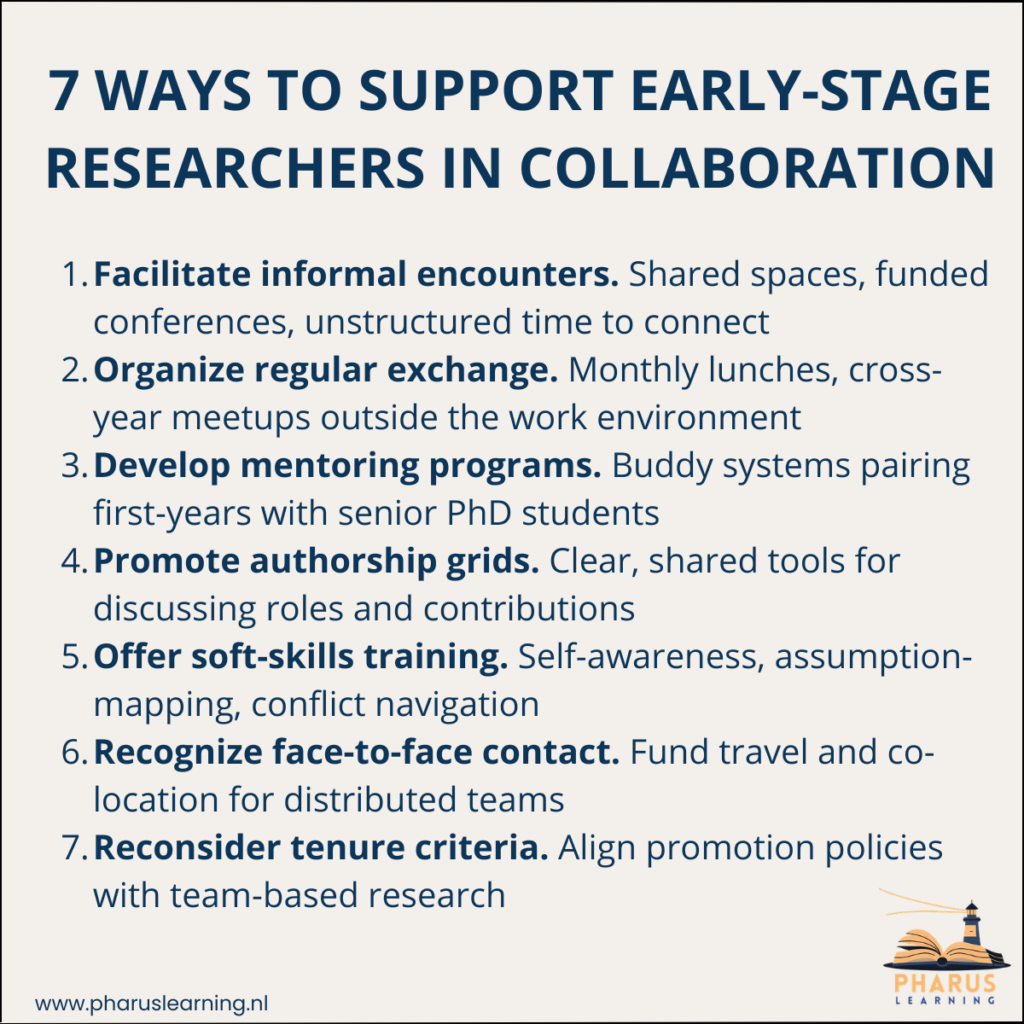
The following will provide seven practical tips for academic departments and PhD coordinators: what they can do to enhance collaborations between PhD students and early-stage researchers.
CREATING THE CONDITIONS FOR CONNECTION
1. Facilitate informal encounters.
Physical proximity and recurring encounters are key drivers of new collaborations. Departments can actively facilitate them: by organising shared workspaces across different research groups, funding conference attendance, and creating recurring informal opportunities for PhD students to meet. Unstructured environments allow spontaneous curiosity to arise and novel ideas to grow freely, outside the boundaries and time pressure of work meetings.
2. Organize regular exchange opportunities.
Opportunities for exchange between PhD students and early-stage researchers should be organized regularly. For example, a monthly departmental get-together over a shared lunch, or a recurrent opportunity for PhD students from different years to meet over funded self-organised initiatives, like a walk in nature or something outside the work environment. Regular get-togethers allow trust to grow naturally, which may reinforce the strength of a nascent collaboration.
BUILDING STRUCTURED SUPPORT
3. Develop mentoring programs.
Mentoring programs would allow more senior students to share strategies for navigating the challenges of academic research with those who have less experience. “Buddy” programs could be established between first-year PhD students and second- or third-year students, for example, with a few planned in-person meetings over the first academic year.
4. Promote the use of authorship grids.
Departments can introduce and encourage the use of authorship grids, structured tools that delineate each author’s responsibilities and expected contributions across the stages of a project. Providing this tool as a standard departmental practice would give researchers with less experience a transparent basis for discussing collaboration roles and a shared reference for managing conflict later on.
5. Offer soft-skills training.
Retreats, workshops, and training on soft-skills development would complement existing preparation in academic writing and research methods. These could include, for example, self-awareness (recognising one’s own challenges in teamwork), assumption-mapping exercises (surfacing implicit expectations about co-authors’ behaviour), conflict navigation (building awareness of one’s own conflict-management style), and framing techniques for handling conflicts, drawn from non-violent communication.
SUSTAINING COLLABORATIONS OVER TIME
6. Recognize the value of face-to-face contact.
Among established teams, frequent face-to-face meetings support effective communication and are associated with greater productivity and research impact. Departments could act on this by funding travel or co-location opportunities for distributed teams, not only for the formation of new collaborations but for their maintenance over time.
RETHINKING INSTITUTIONAL INCENTIVES
7. Reconsider tenure and promotion criteria.
Academic institutions and faculty committees should critically evaluate to what extent existing hiring, tenure, and promotion criteria focus on individual accomplishments or team-based research, and align promotion criteria to best practices to support collaborative contributions, consistent with the discipline’s practices.
KEY TAKEAWAYS
Academia should be a place where (young) researchers are not only able to achieve results, but are doing so in environments built on trust, transparency, and constructive collaborations. Building these skills takes more than guidelines: it takes dedicated space to practice them.
Pharus Learning offers workshops on academic collaborations, interdisciplinary research, and leading collaborative projects for PhD students and early-stage researchers. They are planned as 2-hour hands-on activities that include self-awareness exercises and practical tools to support early-stage researchers building the soft skills needed alongside the technical ones.
If you are the coordinator of a PhD programme, or of a doctoral winter or summer school, feel free to get in touch.
References
DeHart, D. (2017). Team science: A qualitative study of benefits, challenges, and lessons learned. The Social Science Journal, 54(4), 458-467.
Hall, K. L., Vogel, A. L., Huang, G. C., Serrano, K. J., Rice, E. L., Tsakraklides, S. P., & Fiore, S. M. (2018). The science of team science: A review of the empirical evidence and research gaps on collaboration in science. American Psychologist, 73(4), 532–548. https://doi.org/10.1037/amp0000319
Kelly, N., Doyle, J., & Parker, M. (2020). Methods for assessing higher education research team collaboration: Comparing research outputs and participant perceptions across four collaborative research teams. Higher Education Research AndDevelopment, 39(2), 215–119.
Klein, J. T., & Falk-Krzesinski, H. J. (2017). Interdisciplinary and collaborative work: Framing promotion and tenure practices and policies. Research Policy, 46(6), 1055-1061.
McCain, J., Roksa, J., & Breen, S. (2024). Support without Status: Inequities in Student–Advisor Relational Dynamics between First-Generation and Continuing-Generation Doctoral Students. Education Sciences, 14(5). https://doi.org/10.3390/educsci14050441
Meurer, J. R., Fertig, J., Garrison, O., & Shaker, R. (2023). Team science criteria and processes for promotion and tenure of Health Science University Faculty. Journal of Clinical and Translational Science, 7(1), e27.
Newman, J. (2024). Promoting Interdisciplinary Research Collaboration: A Systematic Review, a Critical Literature Review, and a Pathway Forward. Social Epistemology, 38(2), 135–151. https://doi.org/10.1080/02691728.2023.2172694
Patuelli, A., & Carungu, J. (2020). A comparative study of the accounting research trends (1994–2014) between Spain and Italy. Accounting History, 25(3), 488–508. https://doi.org/10.1177/1032373219876355
Phillippi, J. C., Likis, F. E., & Tilden, E. L. (2018). Authorship grids: Practical tools to facilitate collaboration and ethical publication. Research in Nursing and Health, 41(2), 195–208. https://doi.org/10.1002/nur.21856
Pinzón, J. H., Sanchez, G. M., de Lara Machado, W., & de Oliveira, M. Z. (2024). Relationships between postgraduate student mental health and the resources and demands inherent to academic work. Tertiary Education and Management, 30(3), 165–185. https://doi.org/10.1007/s11233-024-09141-6
Van Noorden, R. (2015). Interdisciplinary research by the numbers. Nature, 525(7569), 306–307. https://doi.org/10.1038/525306a
Van Rijnsoever, F. J., & Hessels, L. K. (2011). Factors associated with disciplinary and interdisciplinary research collaboration. Research Policy, 40(3), 463–472. https://doi.org/10.1016/j.respol.2010.11.001