

The Hidden Cost of Academic Collaboration
Working in academia can be exciting. There’s the enthusiasm of discovering something new with every project, of creating knowledge, of searching for and examining evidence that supports or challenges an existing view of a phenomenon. And there’s the particular pleasure of learning from each other when research is collaborative, especially when it involves coauthors with different expertise, from different fields.
For many, collaborative research helps keep a steady pace: brainstorming effectively, dividing tasks, enjoying the journey while having fun, and publishing more than one would as a single author.
But for others, collaboration takes an additional toll. Beyond the cognitive effort (the long hours spent studying the literature, developing a research design, collecting and analysing data), working with coauthors adds another layer of effort: the one required when conflict arises.
For some, authorship disagreements lead to disengagement from academic research altogether, and to real psychological distress, compounding the pressure of already publish-or-perish environments.

Part of the problem is structural. PhD students are usually trained in hard skills (field-specific research design and methodology) but rarely in soft skills: emotional intelligence, conflict management, negotiation. Some departments are starting to integrate this kind of training, but it’s still far from common practice. And the cost of that gap falls not only on the individual PhD student, but on the department as a whole. A PhD student who avoids conflict and doubts their own legitimacy will struggle more throughout their PhD; and that struggle can lead to disengagement, strained relationships with coauthors, and, eventually, leaving academia altogether.
It doesn’t have to be this way. PhD programmes and academic departments can take a real stand against the mental health crisis unfolding in academia (and beyond).
What Is an Authorship Collaboration Grid?
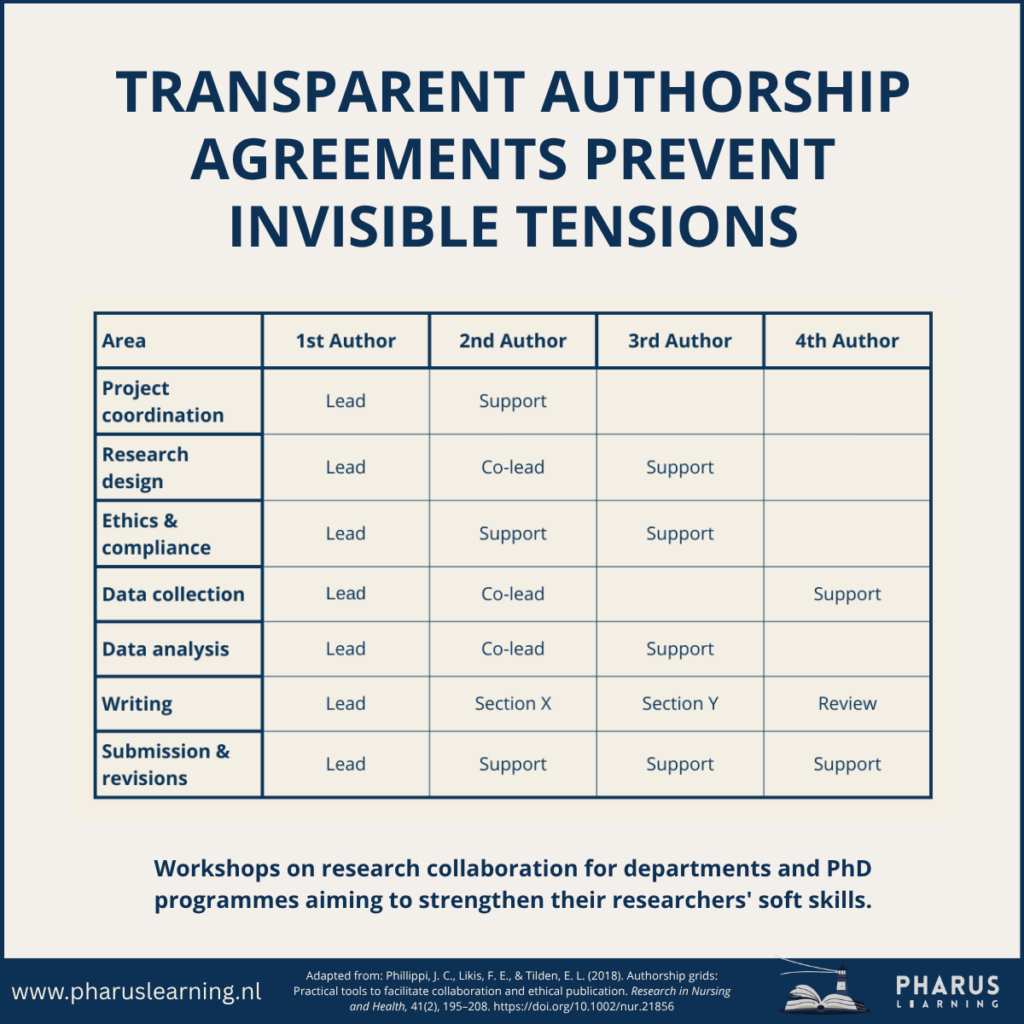
Teaching people how to build fair, transparent authorship agreements is one of the first steps in that direction. Author collaboration grids are simple yet powerful tools that help research teams align expectations before a project begins. They lay out each author’s responsibilities, role, and expectations in a collaborative project.
Using a collaboration grid doesn’t guarantee that authorship conflict won’t happen. But it does give teams a shared reference point: a way to surface and discuss the issues that, left unspoken, tend to resurface project after project, year after year, for anyone who has to learn them the hard way. It can be especially valuable for early-career researchers who would otherwise only learn from experience what usually goes wrong when these things aren’t discussed beforehand.
Once written and agreed upon, a collaboration grid also becomes a reference point for managing conflict later — for instance, when someone doesn’t follow through on what they committed to. And it can serve as a basis for determining authorship order and contribution statements, so that everyone’s work is reflected in the recognition it’s eventually given.
Making Collaboration Grids Standard Practice
Departments and PhD programmes should actively encourage the use of collaboration grids as a way to strengthen ethical authorship practices and rebalance power dynamics in favour of PhD students and early-career researchers, giving them the tools to be active, informed participants in their own research.
Soft skills training should include this kind of tool, helping departments and programmes establish it as standard practice at every level, from PhD students to senior researchers and professors.
Pharus Learning offers workshops on academic collaborations, interdisciplinary research, and leading collaborative projects for PhD students and early-stage researchers. They run as two-hour, hands-on sessions combining self-awareness exercises with practical tools to help researchers build the soft skills that too often get left out of academic training.
If you coordinate a PhD programme, or a doctoral winter or summer school, feel free to get in touch.
References
DeHart, D. (2017). Team science: A qualitative study of benefits, challenges, and lessons learned. The Social Science Journal, 54(4), 458-467.
Hall, K. L., Vogel, A. L., Huang, G. C., Serrano, K. J., Rice, E. L., Tsakraklides, S. P., & Fiore, S. M. (2018). The science of team science: A review of the empirical evidence and research gaps on collaboration in science. American Psychologist, 73(4), 532–548. https://doi.org/10.1037/amp0000319
Kelly, N., Doyle, J., & Parker, M. (2020). Methods for assessing higher education research team collaboration: Comparing research outputs and participant perceptions across four collaborative research teams. Higher Education Research And Development, 39(2), 215–119.
Klein, J. T., & Falk-Krzesinski, H. J. (2017). Interdisciplinary and collaborative work: Framing promotion and tenure practices and policies. Research Policy, 46(6), 1055-1061.
Phillippi, J. C., Likis, F. E., & Tilden, E. L. (2018). Authorship grids: practical tools to facilitate collaboration and ethical publication. Research in nursing & health, 41(2), 195-208.
Pinzón, J. H., Sanchez, G. M., de Lara Machado, W., & de Oliveira, M. Z. (2024). Relationships between postgraduate student mental health and the resources and demands inherent to academic work. Tertiary Education and Management, 30(3), 165–185. https://doi.org/10.1007/s11233-024-09141-6